CHARLESGATE was not built to manage properties. It was built to challenge how properties get managed.
Challenge Conventions is one of CHARLESGATE's five operating values: We question the status quo and relentlessly pursue better ways. We treat it as a filter, rather than a slogan. It shapes how we build teams, align incentives, and choose where to grow. The operating model we built in Boston, and the results it produced in new markets, show that it works.
When we enter new markets, we don't bring the industry's standard playbook and a competitive fee structure. We bring a different operating model. We designed it to align incentives between ownership and operations. It gives every asset deeper operational support than a generalist structure can provide. And it holds resident service to a higher standard than the category has come to expect.
To see why that model produces results the old one cannot explain, you first have to understand what the old model is.
The 1:100 Rule Was Never Built to Perform
For more than twenty years, the National Apartment Association has published a staffing benchmark that quietly defined how most of the industry operates: one employee for every 100 units. It was never a performance target. It was a cost-control formula, and operators treated it as gospel for two decades.
After the pandemic, NAA researchers updated their guidance. They found that a ratio closer to 1:60 is needed to sustain any meaningful level of service. That is more than a minor adjustment. It admits that the original model was designed to survive rather than to perform, and the industry knows the ratio is collapsing under its own weight.
We did not start from 1:100, and we did not update to 1:60. We set the ratio aside and rebuilt the model around a different question. Instead of asking how many units one person can manage, we asked what one person needs to own in order to be brilliant at it.
What the Old Model Looks Like on the Ground
Consider a typical site. Four people cover three buildings and fifty prospects a day, with no AI, no platform, and no clear division of work. Everyone tours, follows up, processes applications, handles renewals, coordinates maintenance, and manages move-ins. Meanwhile, the resident who just knocked on the office door wants to chat for thirty minutes. They do all of it at once, all day, every day. That arrangement is a pile of work with names attached, not a team.
The industry calls this person a generalist. It sounds like a compliment, but it describes someone stretched across too many roles to master any of them. That person works inside a model designed to minimize headcount rather than maximize output.
The data on what this produces is not subtle. Leasing staff turnover runs 33 to 50 percent a year across the industry, and the average leasing consultant stays just 19.2 months. Once you account for recruiting, onboarding, lost conversions, and coverage gaps, replacing that person can cost up to 200 percent of their annual salary. The model meant to control labor costs is one of the most expensive in the business.
Performance follows the same pattern. Average lead-to-lease conversion sits between 15 and 25 percent. For every four qualified prospects who ask about a unit, three walk away without signing. Often they go to a competitor who responded faster, followed up better, or simply had someone available when they called. Research shows that operators who fail to respond within 90 minutes lose roughly half of their inbound leads. At 48 hours, the lead is effectively forfeited.
What Happens When You Run That Model
Tours get rushed because six other tasks are waiting. Follow-ups go out late because the person who just showed a unit is now processing an application by hand, with no platform or automation to speed it up. The resident standing in the doorway gets served while the prospect on hold does not. Everyone is busy, and very little gets done well.
Lease-ups stall at 80 percent because the person responsible for closing also handles everything else. Renewals go out late, and maintenance tickets get lost. Nobody is incompetent. No one can master forty things at once.
This is a structural failure, not a management one. NAA's own research names the causes. Resident-satisfaction measures have grown heavier, post-pandemic scheduling has grown more demanding, and operating technology meant to reduce workload has added complexity instead. None of that ever fit inside the 1:100 model.
Centralization Moves the Problem Without Solving It
The industry is trying to fix this, mostly in the wrong direction.
20for20, led by Dom Beveridge, is the multifamily industry's most cited annual research on operations and technology. Its survey found that 80 percent of third-party multifamily managers are now centralizing operations. Every company surveyed has centralized, started centralizing, or plans to. The industry presents this as progress, but in most cases it is reorganization without reinvention.
What operators are centralizing is administrative work: resident account management, screening, renewals, and back-office functions. They pull the assistant property manager off the property and move those tasks to an offsite team or shared service center. That lowers cost per unit, but it does not improve leasing performance or resident outcomes. A generalist on site is replaced with a generalist somewhere else.
None of the dominant operators have solved the unit-level problem at scale. Picture the property running at 78 percent occupancy because the leasing consultant is also the maintenance coordinator, the renewal specialist, and the person handling a resident dispute, all on the same Tuesday afternoon.
Centralization lets the industry acknowledge a broken model while keeping its structure intact. The generalist role does not disappear. It relocates. We went a different direction.
Challenge Conventions in Action: The Team-Powered Operating Model
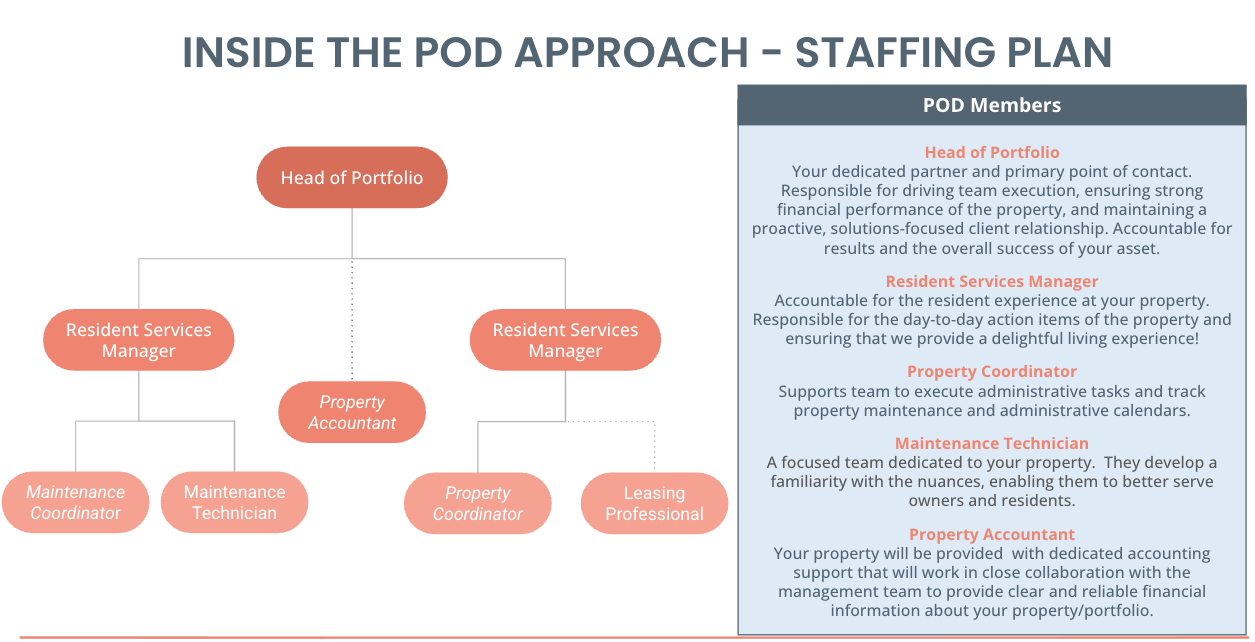
Our approach to property management didn't come from a staffing study. It came out of a conviction that property management had accepted a broken operating model as inevitable. The right response was to rebuild the model from a different premise rather than optimize it.
That premise is that aligned incentives produce better outcomes than managed accountability. When the person responsible for leasing only leases, their success is the property's success. When the operations team owns the resident experience from day one through renewal, their scorecard matches the owner's. When a regional leader is accountable for the whole outcome rather than a single function, the client gets a real partner instead of a vendor rotating through a territory. This is what we mean by aligning incentives: operating structures, not fee structures.
The result delivers what the generalist structure never could. Specialists have the time and focus to go deep, so every level of the asset gets stronger operational support. Resident service rises to a higher standard because hospitality cannot come from someone who is also processing renewals and chasing a maintenance vendor. Owners get an operating partner built to move the property's performance forward, rather than one built to manage its administrative load.
Each role has one job, one owner, and one outcome.
Our leasing agents sell. They don't sit in an office from 9 to 5 hoping someone walks in, and they don't field maintenance tickets while trying to close a lease. They tour, follow up, and convert. When that is your only job, you get very good at it quickly.
Our operations team serves residents. Renewals, delinquency, maintenance coordination, move-ins, and escalations all sit with them. They own the resident relationship from day one through renewal, without the distraction of fifty prospects waiting for a callback.
Our regional leader owns the whole outcome. That role is not a catch-all for whatever falls through the cracks. It is the person accountable for the property's performance: tracking the scorecard, managing the client relationship, and closing the gap when something is off.
Specialization matters for retention as much as for performance. When a leasing agent only leases, the job has a clear shape, a scoreboard, and a path to mastery. The burnout behind the industry's 33 to 50 percent annual turnover is largely a symptom of role ambiguity, where people cannot succeed because success means something different every hour of the day. Specialization improves the property's numbers, and it makes the job worth staying in.
A Structural Change, Not a Staffing Change
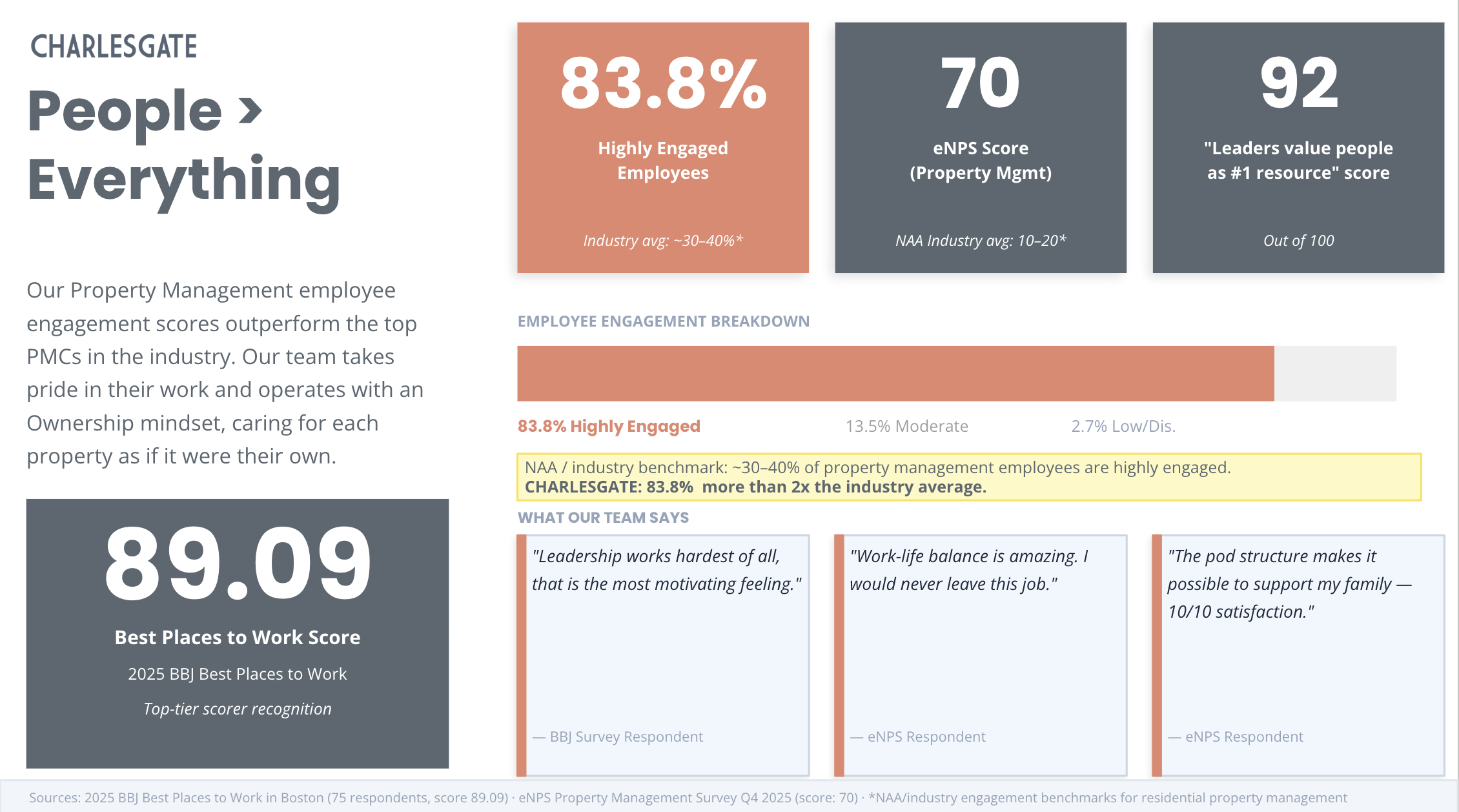 Most centralization efforts keep the same generalist roles and spread them across fewer buildings. The work, the chaos, and the results all stay the same.
We rebuilt who owns what. When a role has one job, the job gets done. When one person is accountable for one outcome, no one else can take the blame, and no one can hide. The leasing number moves, or it doesn't. Response times are fast, or they aren't. Residents renew, or they leave.
Industry renewal rates are at a ten-year high. More than 54 percent of market-rate renters now renew, compared with a pre-pandemic ten-year average of 50.7 percent. That gap of more than three points is concrete. On a 100-unit property, it means three residents stay instead of vacating, and three turns are avoided. Those units never need to be relisted, re-shown, re-processed, and re-leased at a marketing cost that now exceeds $1,000 per lease in most markets. That gap is the difference between a retention-focused operations team and a generalist fielding everything at once.
Specialization makes people better, not just more efficient. Our best leasing agents have stayed in leasing. They could have been promoted, but they stayed because they became great at the one thing they do. That kind of mastery is impossible to fake when you are juggling everything else.
When people focus, they master the work. When they master it, the property wins, and when the property wins, owners stop asking why the scorecard is flat. The old model kept everyone busy. This one keeps the property moving.
The Proof: Denver
Alpine Portfolio and Frameline in Denver comprise four assets and 382 units. Under prior management, the portfolio generated 3 to 4 leads a week. Under the Team-Powered Operating Model, it generates 15 or more. We signed more than 100 leases in the first six months. Peak occupancy rose 35 percent, rents went up, and concessions came down.
Those results come from a model where the leasing agent only leases, the operations team only operates, and the regional leader is accountable for the whole property.
"Charlesgate has been a key differentiator in this market through their strong marketing-to-sales execution and commitment to resident experience."
Alpine Investments, Ownership Partner
When Dom Beveridge reviewed our model, he said something that has stayed with everyone who heard it:
"The idea of a model performing like yours scares the shit out of most other multifamily operators."
Dom Beveridge, Principal, 20for20
He's right. The rest of the industry is centralizing, and CHARLESGATE is specializing. Centralization moves the same broken structure to a cheaper location. Specialization replaces the structure with one that works.
The 1:100 staffing ratio was always a cost formula dressed up as an operating model. The industry spent twenty years optimizing it. We spent that time challenging it and building something different, because questioning the status quo and pursuing better ways relentlessly is what CHARLESGATE does. Denver is not where we tested that value. It is where we proved it, with benchmarks the old model cannot explain.
Request a Portfolio Performance Review. CHARLESGATE manages 5,000+ units across Greater New England and Colorado under its Team-Powered Operating Model. If your property is running the old model, we can show you what the new one looks like.